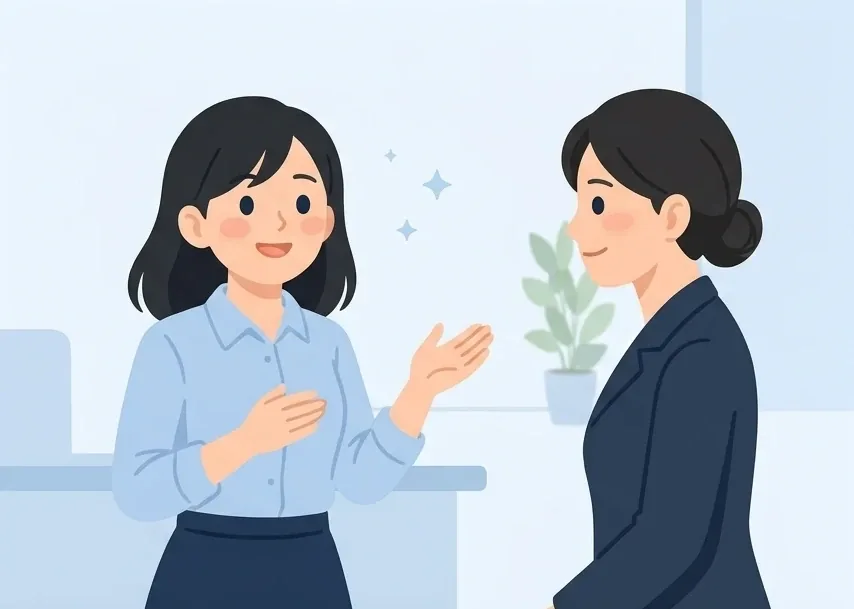
Feelings don't reach anyone unless they are put into words.
To share your feelings, you need words.
Before we begin
Many of the problems that happen in Japan start with relationships between people.
In particular, problems often grow when feelings or thoughts are not properly understood.
What could have been done before it came to that?
“If only I had said it this way.”
“If only I had understood it this way.”
If feelings had been properly shared, if people had understood each other, how many problems could have been avoided?
How the speaker says it, and how the listener understands it. Only when both come together does a good relationship begin.
But knowing words is not enough.
In what situations, and in what way, do you share your feelings? That “way of saying it” matters too.
In what situations, and how, do people in Japan share what they feel?
And wanting to share your feelings is not enough either.
You also need to be able to listen and understand what the other person says.
What Japanese for daily life do you really need to live in Japan and talk with the people there?
Today there are many Japanese textbooks made for exams. Most of them are about getting a high score.
But getting a high score and being able to talk with people in Japan are not the same.
Some people hold N1 or N2 in the Japanese-Language Proficiency Test and still struggle with conversations at work.
Some people at N3 talk with confidence at work.
Japanese for exams and Japanese for life are different.
Day One Japanese is Japanese for living,
for people who want to try talking with people in Japan,
for people who need Japanese to live in Japan,
and for people who need Japanese to work in Japan, including through the Ikusei Shūrō (Employment for Skill Development) system.
From small misunderstandings
All kinds of problems happen in Japan.
The one word you couldn't say.
The nod you gave without understanding.
Small misunderstandings grow into big problems.
And most of them
come from relationships between people.
Thinking it is not enough
No matter how close you are.
No matter how much you care about someone.
If you only think it in your heart,
it won't reach them.
Why putting it into words matters
Understanding each other without words.
That kind of relationship doesn't exist from the start.
And even if you can understand each other without words,
saying it out loud still means something.
“Thank you”
reaches someone directly only when you say it out loud, not just think it.
Put the small “thank yous” into words
There are many cultures and customs in the world, and ways of thinking differ from country to country. To live in Japan and talk with Japanese people, you need to know Japanese culture and customs: how to behave, and how to use words.
For example, we have heard that in one country, there is a way of thinking that “thank you” should be saved for important moments.
Some people from that country who come to Japan say, “Don't Japanese people say ‘thank you’ too much?”
Saving it for truly important moments. That is a lovely way of thinking too.
And in those moments, deep gratitude can also be shared with other words, such as 「本当にありがとうございました」 (thank you so much) or 「心から感謝しています」 (I'm truly grateful).
In Japan, people say “thank you” even for small things to be grateful for, as people from other countries might see them.
Whether the gratitude is big or small, if there is something to be thankful for, people say “thank you.”
When someone opens a door for you. When someone hands you a document. When someone teaches you how to do a task.
Saying “thank you” for each thing you are grateful for. That is an important part of living and working with people in Japan.
We are not talking about relationships where thanks is understood without being said.
We are talking about how much of the small gratitude in everyday life you can put into words.
This matters when you live in Japan, and it is the foundation of good relationships.
Words carry your feelings
It's okay if you can't say it well.
Short is fine. Slow is fine.
Everything begins
when you try to reach someone.
Why you are learning Japanese
For your life.
For your work.
For your family.
To keep living.
Everyone has their own reason for learning Japanese.
Day One Japanese
brings you the words you will use from your very first day in Japan.
Start with the 「ありがとうございます」 you say every day.
With the 「おはようございます」 you say tomorrow morning.
Let's begin together.